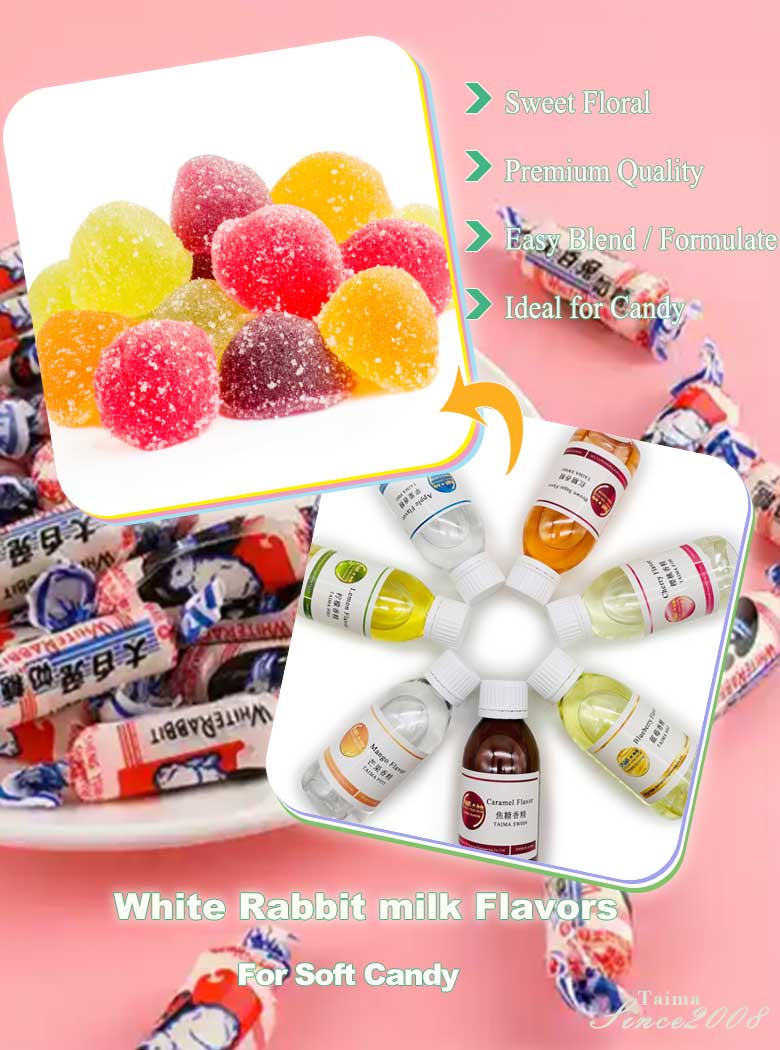
Taima concentrate white rabbit cream candy liquid flavor for soft candy
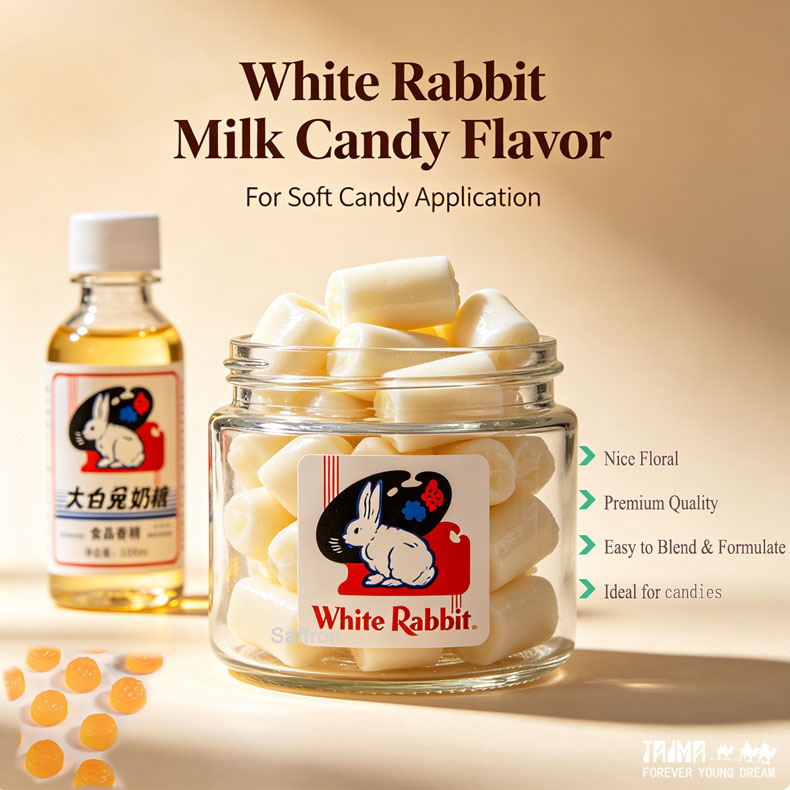
White Rabbit Creamy Candy Flavoring is a mature product used in gummy candy production, giving the product its signature rich, sweet, and creamy aroma:
I. Suitable Gummy Candy Types:
It can be widely used in various gummy candy types, including gelatin gummies, pectin gummies, gelatin gummies, milk-flavored gummies, and QQ gummies. It is also suitable for gummy candy products with fillings, adding flavor to the base or filling. It does not cause significant color changes with the colloidal components of the gummy candy, exhibiting good compatibility.Characteristics and dosage of white rabbit cream candy for gummy bear:
II. Recommended Dosage
1. General-purpose Flavoring: The standard dosage is 0.1%~0.5%, which can be flexibly adjusted according to the target flavor concentration. This is the most commonly used dosage range in gummy candy production.
2. Oil-soluble Flavoring: Suitable for gummy candy cooking processes, the recommended dosage is 0.1%~0.2%. Its heat resistance is more suitable for candy processing scenarios.
3. Water-oil dual-use flavoring: It balances solubility and heat resistance, with a recommended dosage of 0.06%~0.2%, and is suitable for most conventional gummy candy production lines.
III. Different types of flavors for you to choose:
1. Synthetic Fragrances
2. Natural Fragrances
3. Natural Identical Fragrances(most welcome flavors)
Applications of osmanthus flavors
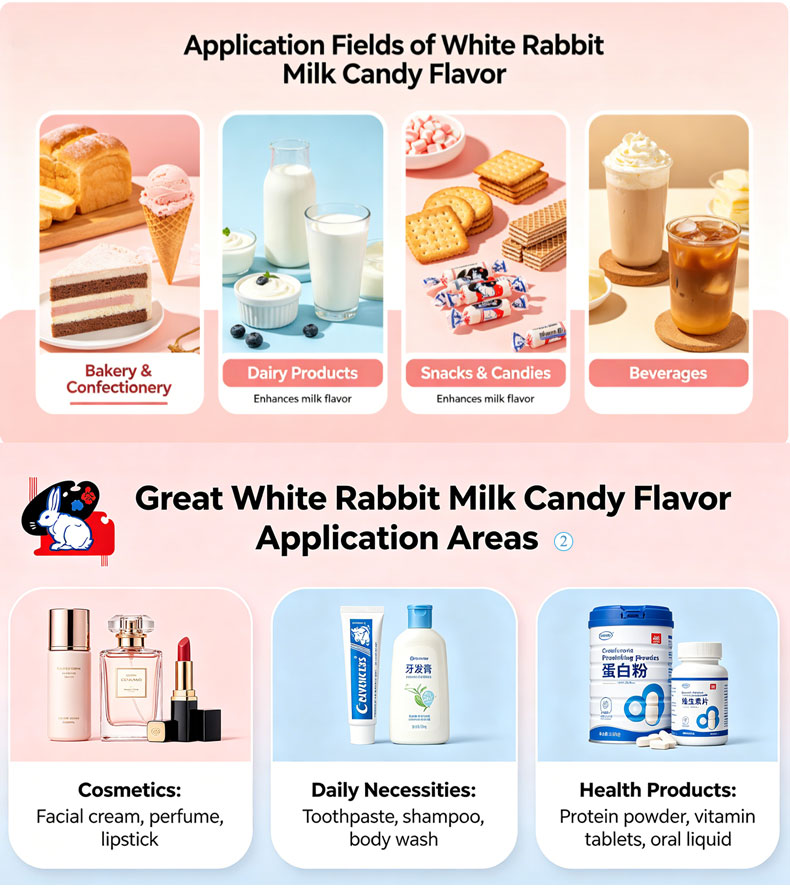
I. Core Food Application Areas:
1. Confectionery: Suitable for hard candy, soft candy, chewing gum, jelly, etc.
2. Baking: Can be added to biscuits, pastries, fillings, bread, etc.
3. Frozen Drinks and Dairy Products: Used in ice cream, popsicles, ice lollies, dairy products, etc.
4. Beverages and Solid Foods: Carbonated beverages, fruit and vegetable beverages, instant solid beverages, oatmeal, soup mixes, etc.
II. Other Extended Application Areas1. Health Foods and Pharmaceuticals: Can be added as a flavoring ingredient to health foods and some pharmaceutical fillers to improve palatability.
2. Daily Chemicals and Cosmetics: Facial cleansers, beauty creams, shampoos, face masks, etc.
3. Animal Feed: Pet food, aquatic feed, etc.
4. Industrial Manufacturing: Creates a specific milky aroma in the flavoring process of some fine chemical products and handicrafts.
Specifcation of Food Flavor
- Refractive index: 80-120
- Purity: 99%
- safaty healthy
- Composition: essence = Base + taste (fragrance/flavors)
- Addition ratio: 0.05%~0.3%
- Flavor type
1) Nature synthesis Flavor (Best-selling );
2) Natural extraction flavoring;
3) synthetic flavor.
Advantages of Flavorings (Food Flavorings/Chemical Flavorings, etc.):
1. Improved Flavor Consistency: Flavorings ensure consistent flavor across batches, avoiding fluctuations caused by seasonality and origin of natural ingredients.
2. More Controllable Costs: Compared to using large quantities of natural ingredients (fruits, spices, dairy products, etc.), flavorings require less but have a stronger effect, significantly reducing formulation costs.
3. More Stable and Long-Lasting Flavor: Flavorings are more stable during processing, heating, and storage, less prone to volatility or deterioration, making them suitable for industrial applications in baking, beverages, and snacks.
4. Ability to Simulate Complex Flavors: Flavorings can reproduce or even enhance natural flavors, such as fruit, milk, tea, and wine aromas, and can also create innovative flavor combinations that do not exist in reality.
5. Increased Product Development Efficiency: They do not rely on seasonal raw material supplies, resulting in shorter R&D cycles and more flexible formulation adjustments.
6. Wide Range of Applications: Widely used in beverages, baking, confectionery, ice cream, condiments, tobacco flavorings, and daily chemical products, among other industries.
Precautions for Use of Neroli flavoring
| (1) | Stir thoroughly after adding to ensure even distribution. |
| (2) | It is recommended to add it at the final stage of the production process, as high temperatures may cause some aroma loss. |
| (3) | After the finished product is made, seal and store at a low temperature to prevent aroma loss. |
| (4) | Matcha flavoring is a food additive and cannot be consumed directly; it can only be added to baking ingredients. |
Food flavor package
1.Shipment:
Door to Door service by FedEx/TNT/DHL
2.payment method:
PayPal, T/T, W/U; Alibaba; Bank transfer...
3.Time delivery:
3 days after we gentting payment;
4.Packing:
First,Fluorinated bottles/bags first;
Next packed by Chunky Aluminium foil bag;
Then in carton box;
Frequently Asked Questions
Everything you need to know about our food flavor solutions.
Contact Veivy for a Quote
Ready to enhance your product's taste? Get in touch today!
Contact on WhatsAppTaima supply Raw materials for more than since 2008:
1. Concentrate flavors: Tobacco flavors, Fruit flavors, Mint flavors, mixed flavors...for e-liquid vape juice.
2. Powder cooling agents: WS-23, WS-3,WS-5, WS-27, WS-12...
3. powder sweeteners: Neotame, Sucralose, Advantame...
4. Other additaves: Sour,Ethyl Malto other enhancer...